- Products
- Segments
- Newsroom
- Tools and Resources
- Sustainability
- We are Nexans
- Search
- Contact us
- Compare
- Sign in


Cables Can Account for Up to 40% of Scope 3 Emissions : How Nexans' Low-Carbon Program Can Help
Jun 28, 2026/FL-EXXE/FL-EXXE-ut-av-jorden.webp/jcr:content/FL-EXXE-ut-av-jorden.webp)
Copper demand 2030
Cobber production capacity 2030
of new supply needed in a decade
For many utilities and DSOs (Distribution System Owners), purchased goods and materials represent the largest share of their carbon footprint. Cable systems and grid investments can account for a significant proportion of Scope 3 emissions – in some cases up to 40%, depending on the company's investment profile and project portfolio.
Through the Nexans Low-Carbon Program, the company is working to reduce the carbon footprint of cable systems without compromising performance or quality.
Norway is undergoing one of the most significant grid expansions in its history. Existing infrastructure must be reinforced and modernized while new industries are connected to the grid. At the same time, requirements for documenting and reducing greenhouse gas emissions throughout the value chain are becoming increasingly stringent.
For utilities, this means that Scope 3 emissions are receiving growing attention. When cable systems represent a substantial share of the carbon footprint associated with grid expansion, material choices become a strategic decision.
Download the Nexans Position Paper "Recycling, Circular Economy & Low-Carbon Products" to learn more.
Materials Are the Key to Lower Scope 3 Emissions
If the energy sector is to successfully reduce Scope 3 emissions, the journey must start with materials.
Metal conductors typically account for between 70 and 90 percent of a cable's cradle-to-gate carbon footprint. This means that decisions regarding metals and raw materials have a major impact on the overall emissions profile.
This is the starting point for the Nexans Low-Carbon Program – a global initiative designed to reduce the carbon footprint of cable systems across the entire value chain, based on concrete plans, documented data and long-term commitments.
The program aims to increase the share of recycled materials, reduce emissions associated with raw materials and provide greater transparency regarding the environmental performance of cable products. It is also a key enabler in achieving Nexans' net-zero ambition by 2050.
READ MORE: Our efforts to reduce CO2 emissions
Transparency Is Becoming Increasingly Important
To reduce Scope 3 emissions, companies first need to understand where emissions occur.
A central element of the Nexans Low-Carbon Program is therefore to provide customers with greater transparency regarding the materials used in its products. Through the program, Nexans discloses information such as recycled metal content, the type of aluminium used and the product's documented carbon footprint – information that can often be difficult to extract from traditional environmental declarations alone.
This provides utilities and project developers with a stronger basis for Scope 3 accounting, life cycle assessments and future procurement decisions. Greater transparency around material content and carbon footprint is becoming increasingly important, not least because climate and environmental criteria are now required to play a significant role in public procurement processes across many European markets.
Recycled Copper Is Part of the Solution
Global copper demand is expected to reach approximately 40 million tonnes by 2030, while available production capacity is estimated at around 33 million tonnes.
Increasing the use of recycled copper is therefore one of the most important levers for reducing both carbon emissions and pressure on global raw material resources.
Nexans has set a target of sourcing 25 percent of its copper from recycled sources by 2028. Through initiatives such as CableLoop, investments in its own smelting and metal-processing capabilities, and the development of new circular material loops, the company is working to keep valuable materials in circulation for as long as possible.
READ MORE: Our Work on the Circular Economy
Low-Carbon Aluminium Can Deliver Significant Emission Reductions
At the same time, the use of low-carbon aluminium is increasing across several product families.
To accelerate this transition, Nexans is collaborating with Norsk Hydro on the development and use of low-carbon and recycled aluminium for cable manufacturing. The partnership illustrates how close collaboration across the value chain can help reduce the carbon footprint of future electrification projects.
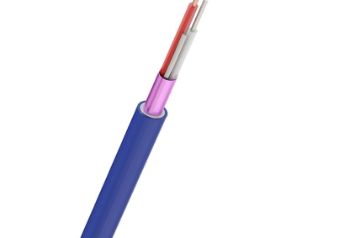
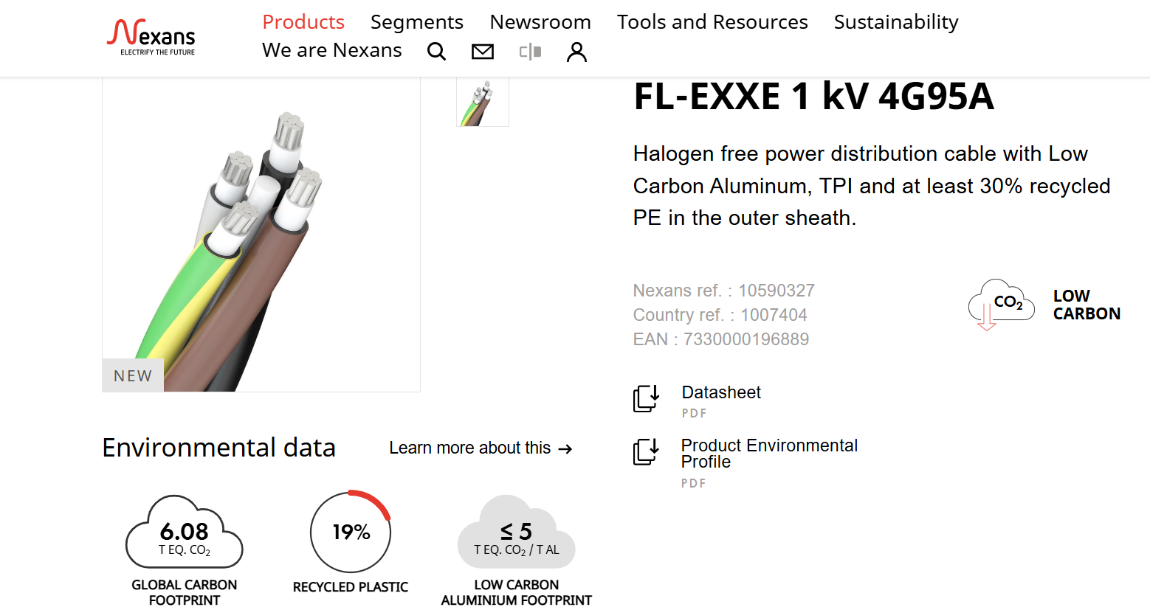
FL-EXXE 1 kV and YSLF 24 kV are two examples of products included in the Nexans Low-Carbon Program.
-
FL-EXXE 1 kV combines low-carbon aluminium with recycled plastic in the outer sheath. Based on third-party verified Environmental Product Declarations (EPDs), the cable can reduce carbon emissions by up to 50 percent compared with conventional alternatives.¹
-
YSLF 24 kV combines low-carbon aluminium with Nexans' thermoplastic insulation technology (TPI). Compared with traditional medium-voltage cables, the solution can reduce carbon emissions by up to 35 percent while also enabling more circular material flows.
Unlike conventional cross-linked polyethylene (PEX) insulation, TPI can be remelted and recycled at end of life. At the same time, the technology remains fully compatible with existing installation methods, joints and terminations.
READ MORE: Our work with EPD/PEPs
Long-Term Commitments Are Essential
Reducing Scope 3 emissions across the energy sector requires more than new products alone.
It requires long-term investments, clear commitments and collaboration throughout the value chain.
If we are to achieve our shared climate ambitions, manufacturers, utilities and raw material suppliers must work together to increase the use of recycled and low-carbon materials. Long-term partnerships and clear commitments will be essential to scaling these solutions and reducing the carbon footprint of future power grids.
Download Our New Position Paper
How can circularity, low-carbon materials and greater transparency help reduce Scope 3 emissions from future power grids?
Download the Nexans Position Paper "Recycling, Circular Economy & Low-Carbon Products" to learn more.
Facts: Nexans Low-Carbon Program
- Global copper demand is expected to reach 40 million tonnes by 2030.
- Available global production capacity is estimated at approximately 33 million tonnes.
- Metal conductors account for between 70 and 90% of a cable's cradle-to-gate carbon footprint.
- Nexans aims to source 25% of its copper from recycled sources by 2028.
- Nexans is committed to achieving net-zero emissions by 2050.
Our websites
Select your country to find our products and solutions
-
Africa
- Africa
- Ghana
- Ivory Coast
- Morocco
- North West Africa
- Americas
- Asia
- Europe
- Oceania